
When people think about e-commerce, they usually picture the obvious stuff: scrolling through products, adding something to the cart, and checking out in a few clicks. It feels quick, easy, almost effortless.
But that’s only the surface.
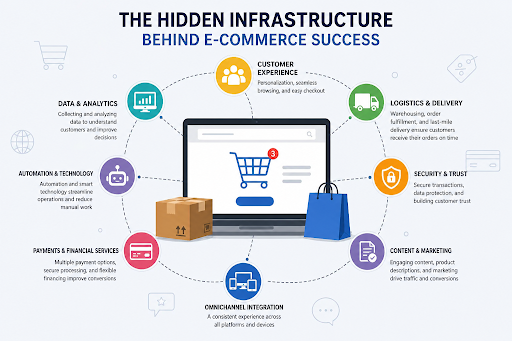
Behind every smooth online shopping experience is a system doing a lot of heavy lifting. Orders are being routed, payments are being verified, inventory is being updated, and data is constantly being analyzed—all in real time.
The truth is, e-commerce today isn’t just about selling products online. It’s about building a system that works quietly in the background and gets everything right—every time.
Let’s break down what’s actually going on behind the scenes, in a way that makes sense without sounding like a technical manual.
It All Starts with Understanding the Customer
Every click tells a story.
When someone visits a website, what they look at, how long they stay, what they ignore—it all becomes useful information. Smart e-commerce businesses don’t just collect this data; they actually use it.
Over time, this helps them understand patterns:
- What people are interested in
- What makes them leave
- What pushes them to buy
So if someone is browsing a swarovski necklace, the platform might start showing similar styles, matching accessories, or even limited-time offers. It’s not random—it’s based on behavior.
When done right, this doesn’t feel intrusive. It just feels like the website “gets” you.
Delivery Is Where Promises Are Tested
You can have the best product in the world, but if delivery is slow or unreliable, people won’t come back.
This is why logistics has become one of the most important parts of e-commerce.
Brands today are investing in:
- Warehouses closer to customers
- Smarter delivery routes
- Real-time tracking systems
Customers don’t just want fast delivery—they want predictable delivery. They want to know when their order will arrive and trust that it actually will.
That reliability builds loyalty more than any discount ever could.
Trust Is Everything (Even More Than Price)
Think about it—why do you trust some websites instantly, while others feel a bit off?
It usually comes down to small details:
- Clear return policies
- Honest reviews
- Secure checkout pages
- Professional design
All of these signals tell customers: “You’re safe here.”
There’s also a technical side to trust. Platforms need to make sure that user information is accurate and secure. Something as simple as verifying addresses properly can prevent failed deliveries and reduce fraud.
It’s not flashy, but it makes a big difference.
Content Isn’t Just Marketing Anymore
A few years ago, product pages were basic. A photo, a price, maybe a short description.
That doesn’t work anymore.
Today, customers expect more. They want to understand what they’re buying.
That’s where content comes in.
Good e-commerce brands invest in:
- Detailed product descriptions
- High-quality images
- Videos showing the product in use
- Reviews from real customers
For example, if someone is considering buying a tissot watch, they’re not just buying a product—they’re buying into craftsmanship, design, and brand reputation. That story needs to be communicated clearly.
When content is done well, it answers questions before the customer even asks them.
Payments Can Make or Break the Sale
You’d be surprised how many people abandon their cart at the final step.
Often, it’s not because they changed their mind—it’s because something felt inconvenient.
Maybe:
- The payment options were limited
- The process felt too long
- The pricing wasn’t clear
That’s why modern e-commerce platforms are investing heavily in better financial services.
Things like:
- Buy Now, Pay Later
- Multiple payment methods
- Fast, one-click checkouts
These small improvements remove friction and make it easier for people to actually complete their purchase.
Automation Keeps Everything Running Smoothly
Imagine trying to manage thousands of orders manually. It wouldn’t work.
That’s where automation comes in.
Behind the scenes, systems are:
- Updating stock levels instantly
- Sending order confirmations
- Handling basic customer support
- Managing marketing emails
Automation doesn’t just save time—it prevents mistakes.
And as a business grows, it becomes the only way to keep things running without everything falling apart.
Customers Don’t Think in “Channels”
From a business perspective, there are different channels: website, app, social media, email.
But customers don’t see it that way.
To them, it’s all one experience.
They might:
- Discover a product on Instagram
- Check it later on a laptop
- Finally buy it from their phone
If that experience feels disconnected, it creates friction.
That’s why e-commerce brands are focusing on omnichannel experiences—making everything feel consistent no matter where the customer interacts.
The Small Detail That Causes Big Problems: Addresses
This one sounds simple, but it’s a big deal.
If a customer enters the wrong address, the entire process breaks:
- Deliveries fail
- Costs increase
- Customers get frustrated
That’s why tools that help standardize and verify addresses are so important—especially for platforms handling large volumes of orders.
It’s one of those invisible things that customers never notice… unless it goes wrong.
Security Is Quiet—but Critical
Most customers don’t think about security while shopping. They just expect it to be there.
But behind the scenes, a lot is happening:
- Payment data is encrypted
- Accounts are protected
- Systems are monitored for suspicious activity
If something goes wrong, trust is lost instantly—and it’s very hard to rebuild.
That’s why strong security isn’t optional. It’s a foundation.
Where E-Commerce Is Headed Next
E-commerce is still evolving, and a few trends are starting to stand out:
- Smarter personalization: Websites will get even better at predicting what customers want
- Faster experiences: Delivery times will continue to shrink
- More flexible payments: Financial tools will become more integrated
- Sustainability: Customers will care more about how products are delivered
The businesses that win won’t just follow these trends—they’ll build systems that adapt to them quickly.
Final Thought
What makes e-commerce work isn’t just what customers see—it’s everything they don’t see.
The systems, the processes, the tiny details that quietly ensure everything runs smoothly.
When all of these pieces come together, the experience feels simple. Effortless, even.
And that’s exactly the point.