
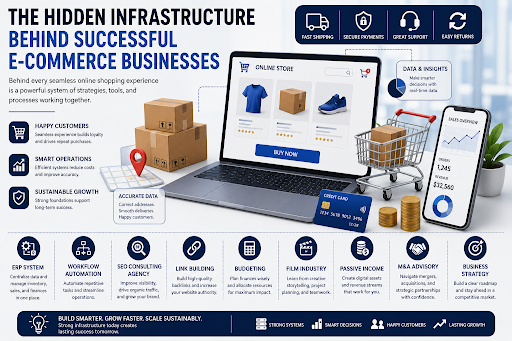
E-commerce is often viewed through the lens of attractive websites, engaging product pages, and seamless checkout experiences. While these customer-facing elements are important, they represent only a fraction of what makes an online business successful. Behind every thriving e-commerce operation is a sophisticated infrastructure that manages inventory, logistics, customer data, marketing, and financial performance.
As competition grows across digital marketplaces, businesses can no longer rely solely on quality products or competitive pricing. Success increasingly depends on operational efficiency, scalability, and the ability to make informed decisions quickly. Companies that invest in the right systems and processes gain a significant advantage in an environment where customer expectations continue to evolve.
Understanding the hidden infrastructure that supports e-commerce growth can help entrepreneurs and business leaders build stronger, more resilient operations capable of sustaining long-term success.
Why Operational Foundations Matter
Many online stores launch with simple tools and manual processes. Initially, these methods may be sufficient. However, as sales volume increases, operational complexity grows rapidly.
Order fulfillment, inventory tracking, customer support, supplier management, and financial reporting all require careful coordination. Without structured systems in place, businesses often encounter delays, inaccuracies, and customer dissatisfaction.
Strong operational foundations create consistency and enable businesses to scale without sacrificing quality. They also allow organizations to respond more effectively to market changes and customer demands.
The Role of Accurate Customer and Shipping Data
One of the most overlooked aspects of e-commerce is data accuracy. Incorrect customer information can lead to failed deliveries, higher operational costs, and damaged customer relationships.
Address verification tools, location databases, and testing environments help businesses ensure that customer information is captured correctly before orders are processed. This becomes especially important for organizations operating across multiple regions and countries.
Reliable address management systems reduce delivery issues, improve logistics performance, and enhance overall customer satisfaction.
Creating Efficient Back-Office Operations
The customer may only see a completed purchase, but numerous processes occur behind the scenes. Product sourcing, inventory management, accounting, and vendor coordination all contribute to the customer experience.
Many organizations implement an ERP system to centralize business operations and improve visibility across departments. By integrating inventory, purchasing, sales, finance, and reporting functions, businesses can reduce data silos and improve decision-making.
A centralized approach allows teams to work more efficiently while ensuring that critical information remains accessible throughout the organization.
Streamlining Growth Through Automation
Manual processes can quickly become bottlenecks as e-commerce operations expand. Tasks such as updating inventory levels, sending order confirmations, generating reports, and managing customer inquiries consume valuable time.
Implementing Workflow Automation enables businesses to eliminate repetitive activities and improve operational efficiency. Automated systems can handle routine processes with greater accuracy while allowing employees to focus on strategic initiatives.
As a result, organizations can scale more effectively without significantly increasing administrative workloads or operational costs.
Building Sustainable Customer Acquisition Channels
Attracting new customers remains one of the biggest challenges in e-commerce. Businesses invest heavily in advertising, social media campaigns, and content marketing to increase visibility.
However, sustainable growth often depends on organic traffic generated through search engines. Working with a reputable SEO consulting agency can help businesses improve search rankings, increase website visibility, and attract qualified visitors.
Search engine optimization provides long-term benefits by creating a consistent stream of potential customers without requiring continuous advertising expenditures.
The Importance of Authority and Trust Online
Search engines increasingly evaluate websites based on credibility and authority. As a result, businesses must focus not only on content quality but also on building trust signals across the web.
One effective strategy involves Link building, which helps strengthen a website’s authority by earning references from reputable sources. High-quality backlinks can improve search visibility while exposing brands to new audiences.
When combined with valuable content and strong user experiences, a strategic link-building approach contributes significantly to long-term digital growth.
Financial Discipline and Growth Management
Rapid sales growth can be exciting, but it can also create financial challenges if not managed properly. Inventory purchases, shipping expenses, technology investments, and marketing costs must be carefully monitored.
Effective Budgeting helps businesses allocate resources strategically while maintaining healthy cash flow. Financial planning enables organizations to anticipate expenses, evaluate investment opportunities, and prepare for unexpected challenges.
Companies that establish disciplined budgeting practices are better positioned to sustain growth during both favorable and difficult economic conditions.
Learning from Other Industries
Innovation often emerges when businesses apply lessons from unrelated sectors. The Film Industry, for example, provides valuable insights into project management, audience engagement, and content creation.
Film production requires collaboration among diverse teams working toward a common objective while managing strict deadlines and budgets. E-commerce businesses can adopt similar approaches when coordinating product launches, marketing campaigns, and customer experience initiatives.
Cross-industry learning encourages creative problem-solving and helps organizations discover new ways to improve performance.
Turning Digital Assets Into Long-Term Revenue
Many entrepreneurs initially focus on immediate sales. However, successful e-commerce operators often look beyond short-term transactions and seek opportunities to create recurring value.
Content websites, affiliate programs, digital products, and subscription services can generate Passive Income streams that complement traditional retail operations. These revenue sources reduce dependence on direct product sales while increasing business stability.
Diversified income streams also provide greater flexibility during market fluctuations and changing consumer behaviors.
Strategic Decision-Making in Competitive Markets
As businesses grow, tactical decisions become increasingly intertwined with long-term objectives. Companies must determine where to invest resources, which markets to enter, and how to differentiate themselves from competitors.
Developing a clear Business Strategy helps organizations align daily operations with broader goals. Strategic planning supports more effective decision-making and ensures that growth initiatives contribute to sustainable success.
Businesses with clearly defined strategies are generally better equipped to adapt to evolving market conditions and emerging opportunities.
Preparing for Expansion and Acquisition Opportunities
Many e-commerce companies eventually reach a stage where mergers, acquisitions, or strategic partnerships become viable growth options. These transactions can provide access to new markets, technologies, customer segments, and operational capabilities.
Professional M&A advisory services help businesses evaluate opportunities, conduct due diligence, and navigate complex negotiations. Expert guidance can reduce risks while maximizing value during significant corporate transactions.
Organizations that prepare early for potential acquisitions often enjoy greater flexibility when opportunities arise.
Data-Driven Decision Making as a Competitive Advantage
Modern e-commerce generates vast amounts of information. Every customer interaction, website visit, purchase, and support request contributes valuable data that can inform business decisions.
Companies that effectively analyze this information gain insights into customer preferences, purchasing behaviors, operational performance, and market trends. These insights enable organizations to make proactive adjustments rather than reactive decisions.
Data-driven cultures encourage continuous improvement and create opportunities for innovation across all areas of the business.
Future-Proofing E-Commerce Operations
Technology continues to reshape the e-commerce landscape. Advances in artificial intelligence, predictive analytics, cloud computing, and automation are creating new opportunities for businesses to improve efficiency and customer experiences.
Future-ready organizations prioritize adaptability. They invest in scalable infrastructure, continuously evaluate emerging technologies, and foster a culture of innovation.
By remaining flexible and responsive, businesses can navigate industry changes more effectively while maintaining a competitive advantage.
The Human Element Remains Essential
While technology plays a critical role in modern commerce, people remain at the center of every successful business. Employees, customers, suppliers, and partners all contribute to organizational success.
Strong leadership, clear communication, and customer-focused cultures continue to differentiate outstanding businesses from their competitors. Technology should support these relationships rather than replace them.
Organizations that balance technological advancement with human-centered values often achieve stronger long-term outcomes.
Conclusion
Successful e-commerce businesses rely on much more than attractive websites and popular products. Their growth is supported by robust operational systems, efficient processes, strategic planning, and continuous innovation. By investing in scalable infrastructure, maintaining accurate data, optimizing workflows, and embracing forward-thinking approaches, organizations can build resilient operations capable of thriving in an increasingly competitive digital marketplace. Businesses that strengthen their foundations today will be best positioned to seize the opportunities of tomorrow.