
Introduction
Every city has places that mean more than they seem to at first glance. It might be an old house, a theater, a hotel or even a stretch of sidewalk. On its own, there may be nothing remarkable about it. What happened there is what people remember.
This is especially true when celebrities are involved. A house that once belonged to a famous musician can continue attracting attention decades later. At the same time, major American landmarks draw visitors for their history, beauty or cultural importance.
The reasons for visiting aren’t always complicated. People hear about a place for years and eventually want to see it themselves. They want to know whether it looks the way they imagined. Sometimes it does. Quite often, it doesn’t.
When an Ordinary Address Stops Being Ordinary
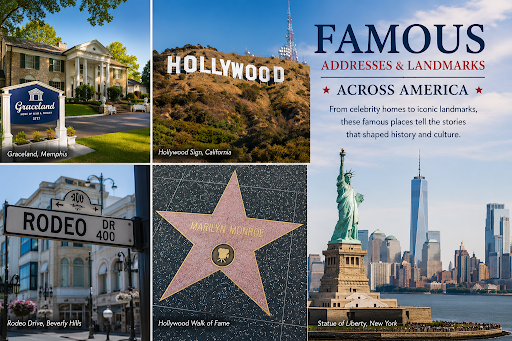
Graceland is difficult to separate from Elvis Presley.
He bought the Memphis property in 1957, when his career was taking off. It was his home for about two decades, and today it remains closely connected with his life and music.
People don’t visit because they’re interested in Tennessee real estate. They go because of Elvis.
A longtime fan might recognize details from photographs or documentaries. Someone who knows less about him may simply be surprised by the decoration. Either way, walking around a person’s home provides a different experience from looking at old concert photographs.
It makes the story more physical.
Los Angeles has plenty of addresses with their own stories. Some are remembered for good reasons and others aren’t.
The former 10050 Cielo Drive falls into the second group. It became notorious after the 1969 murders committed there by members of the Manson Family. The original house is gone, but people still recognize the address because the events became such a widely discussed part of Hollywood history.
That alone shows how powerful the story behind a location can be. A building doesn’t even have to survive for people to remember where it stood.
Neverland Was Never Just a House
Michael Jackson’s Neverland Ranch attracted a different kind of attention.
At the peak of Jackson’s fame, the property seemed to belong in its own world. It wasn’t simply a large California home. It became known for its rides and entertainment facilities, which naturally attracted enormous media interest.
For fans, Neverland was connected to Jackson’s unusual public image. It was extravagant and very different from the way most people lived.
The way people talk about the property has changed, though. Later controversies surrounding Jackson complicated its place in popular culture.
Places don’t get to choose what they’re remembered for. Their reputations follow the people and events connected to them.
Marilyn Monroe’s final home in Brentwood is another example. It wasn’t a giant Hollywood palace. Its significance comes mainly from its connection with Monroe and the final months of her life.
Frank Sinatra’s Twin Palms estate tells a completely different story. The Palm Springs property is closely associated with the glamour and social life surrounding Sinatra’s era.
Different houses. Different histories.
Without the names attached to them, most people outside their neighborhoods would probably never know they existed.
Why Are We So Curious?
There’s no deep explanation required for all of this. People are curious about famous people.
That’s why celebrity-home tours exist.
Tourists visiting Los Angeles can spend hours being driven around neighborhoods associated with actors, musicians and other public figures. In some cases, there isn’t much to see. A high wall or closed gate might hide almost everything.
Yet people still look.
The attraction isn’t necessarily the house. It’s being able to say, “That’s where they lived.”
Beverly Hills has benefited from this association for decades. Luxury homes and expensive shopping are certainly part of its reputation, but Hollywood helped turn the area into something recognizable far beyond California.
Malibu has a similar appeal. Its beaches and scenery are enough to make it desirable, but its history as a home for wealthy entertainers added to the image.
There’s an obvious limit to this curiosity. Historic properties that welcome visitors are public attractions. The current homes of celebrities aren’t. Being interested in someone’s career doesn’t give anyone permission to interfere with their privacy.
The Landmarks Everyone Recognizes
Celebrity homes are usually important because of one person. America’s major landmarks tend to carry much bigger stories.
The Statue of Liberty is probably one of the easiest examples.
People who have never visited New York can recognize it instantly. Over time, the statue became associated with freedom and immigration, particularly because of its location near the historic gateway through which so many newcomers entered the country.
Then there’s the Hollywood Walk of Fame.
It’s a strange attraction when you think about it. Visitors travel from around the world and become excited about finding a name written on the ground.
But stand there for a few minutes and the appeal becomes obvious.
Someone spots the name of an actor they love. Another person finds a musician their parents used to play at home. They stop, take a picture and move on.
It becomes personal very quickly.
Some Places Don’t Need a Celebrity
Nobody needs to tell the Grand Canyon how to attract tourists.
Its reputation comes from the landscape itself. Photos help, but they don’t really prepare visitors for the size of the place. Standing at the edge and seeing how far it stretches is a completely different experience.
Yellowstone has the same kind of pull. Its wildlife, geysers and landscapes give people reasons to visit without any celebrity connection.
Political and historical landmarks work differently again.
The White House is famous partly because it is still being used for its original purpose. It isn’t merely a preserved building from another period. Presidents continue to live and work there.
Mount Rushmore is immediately recognizable too, although discussions surrounding its history have become more complicated over time.
That’s worth remembering. A landmark can be famous without everyone agreeing about what it represents.
When the Movies Get Involved
Film has probably created more famous addresses than most people realize.
Sometimes filmmakers choose locations that are already well known. The Empire State Building can establish New York as the setting of a scene before anyone says a word.
But an ordinary place can also become famous because it appeared on screen.
Imagine a small restaurant being used in a movie. At first, it’s simply a convenient filming location. Then the movie becomes successful. Fans search for the restaurant, visit it and post photographs.
The business hasn’t moved. The food might not have changed.
What changed was the story.
The TCL Chinese Theatre in Hollywood is an interesting mixture of both. The theater has its own history, but decades of movie premieres and celebrity appearances turned it into something beyond a place to watch films.
Many visitors spend more time outside looking at the famous handprints and footprints than they do thinking about what’s playing inside.
Famous Places Keep Local Businesses Busy
There’s another side to all this that isn’t as glamorous: money.
A tourist rarely visits one attraction and spends nothing else.
Someone flying to Memphis to see Graceland might book a hotel for two nights. They’ll probably eat several meals in the city. They may visit another museum, buy souvenirs or pay for transportation.
The same person who bought one Graceland ticket has now spent money with several local businesses.
Scale that up across thousands of visitors and the effect becomes much more important.
This is one reason cities care about protecting well-known attractions. History and culture matter, but tourism also supports jobs.
Famous places can be useful educationally too. There is a difference between reading about where something happened and actually standing there.
You notice little things.
A room is smaller than expected. Two buildings are much closer together than they looked in photographs. An object you’ve seen in books suddenly has an actual size.
Those details aren’t dramatic, but they can change the way someone understands a story.
The Place Stays, but the Meaning Changes
An address doesn’t have an opinion about its own history.
People do.
That’s why the meaning of a famous place can change without the place moving an inch.
One generation might remember a celebrity mainly for their work. Another may focus on controversies that became known later. Historians can also uncover information that changes how people understand a monument or historic building.
Sometimes the physical place changes as well. Houses are remodeled. Buildings disappear. Neighborhoods develop around them.
Still, the old story can survive.
That’s what happened with many addresses that remain part of popular culture even though very little of the original location is left.
Conclusion
Maybe people visit famous places because seeing something in person makes it easier to believe that the stories actually happened.
Elvis really lived at Graceland. Hollywood stars really walked into those theaters. Generations of visitors really stood beneath the Statue of Liberty. The Grand Canyon really is as enormous as everyone says.
A map can tell us where these places are, but it can’t explain why anyone cares about them.
For that, you need the story.
And sometimes the story is enough to turn an ordinary address into a place people remember.
Meta Title: Top USA Addresses to Generate: From Famous Celebrities to Iconic Landmarks
Meta Description: Discover famous celebrity addresses and iconic US landmarks, and learn how these places became part of American culture, history, and tourism.