
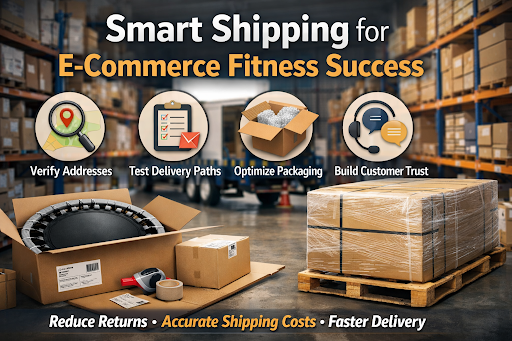
When people think about e-commerce fitness brands, they picture sleek websites, inspiring transformation stories, and high-performance gear. What they don’t see is the complex operation happening behind the scenes—the packaging decisions, the shipping calculations, and the address checks that determine whether a customer receives their order smoothly or faces delays and frustration.
In the world of online fitness retail, logistics isn’t just a back-end function. It’s part of the customer experience. A smooth delivery builds trust. A failed shipment creates doubt.
If you’re running or planning to scale a fitness e-commerce store, understanding how to manage shipping intelligently can protect your profits and your reputation.
Fitness Products Aren’t “Standard” Shipments
Unlike clothing or small electronics, fitness equipment ranges from compact and lightweight to oversized and heavy. That range creates real logistical challenges.
Take a compact Rebounder, for example. It may not weigh as much as larger machines, but it still has a metal frame and tension system that need protection. A poorly packed box can lead to bent parts and immediate return requests.
Meanwhile, larger items, like a 14ft trampoline, aren’t standard parcels—they require freight handling, curbside delivery coordination, and confirmation that the customer’s address can accommodate a truck. If the delivery team shows up and there’s no driveway access, you’re looking at extra fees and delays.
These differences mean your fulfillment system can’t rely on generic shipping rules.
Address Accuracy Is More Powerful Than You Think
It sounds simple: customers enter their address, you ship the product. But in reality, incomplete or incorrect address details are one of the biggest hidden profit drains in e-commerce.
Missing apartment numbers, incorrect ZIP codes, or misspelled city names can result in failed delivery attempts, returned packages, extra carrier charges, and frustrated customers.
Using reliable address validation tools helps catch errors before an order is processed. Even better, testing your checkout system with realistic address formats ensures your shipping calculator and carrier integrations work properly. Small improvements here can dramatically reduce operational headaches later.
Customers Don’t Just Buy Equipment — They Buy Convenience
In fitness e-commerce, the buying decision often comes down to convenience. Customers want to click, pay, and trust that their new equipment will arrive on time and without complications.
Unexpected shipping costs are one of the top reasons people abandon their carts. Transparent shipping calculations—based on properly validated addresses—help avoid that friction. When customers see accurate pricing upfront, they feel in control. And when they feel confident, they complete the purchase.
Test Before You Scale
As your brand grows, you’ll likely expand into new regions or partner with additional carriers. This is where testing becomes critical.
Before launching nationwide freight shipping, for example, you should simulate deliveries to urban apartments, suburban homes, rural areas, and gated communities. Address testing tools allow you to check whether your checkout system recognizes different formats and whether your carrier rules apply correctly.
Imagine discovering after launch that your freight partner doesn’t deliver to certain rural ZIP codes. That’s a costly lesson. Testing protects you from those surprises.
Packaging Is More Than Protection — It’s Brand Perception
When customers receive fitness equipment, their first physical interaction with your brand is the box. If it’s crushed, poorly sealed, or oversized, their excitement fades quickly. Even if the product inside is fine, the perception of quality suffers.
At the same time, over-packaging increases dimensional weight costs. Larger boxes mean higher carrier fees. The solution is balance: strong reinforcement for metal parts, protective padding where necessary, packaging sized closely to the product, and clear labeling for heavy items.
Testing packaging alongside address validation ensures that your shipping cost estimates match reality.
Smart Fulfillment Builds Customer Loyalty
In a competitive market, customer retention is everything. A smooth delivery experience often determines whether someone becomes a repeat buyer.
When a customer orders equipment and it arrives on time, without damage, and with clear delivery communication, they’re far more likely to recommend your brand and return for future purchases. Operational reliability quietly strengthens your brand image.
Returns Are Expensive — Prevention Is Cheaper
Fitness equipment returns can be especially costly. Customers may misjudge space requirements, change their minds, or struggle with delivery access.
To reduce return rates, provide clear dimension guides with visuals, include setup space recommendations, confirm delivery conditions before dispatch, and validate addresses thoroughly at checkout. Even a simple confirmation email for larger orders can prevent misunderstandings.
For instance, customers buying a Rebounder may need to see a visual of their available floor space to ensure it fits safely.
Geographic Data Can Guide Smarter Growth
Address data isn’t just for shipping—it’s strategic. By analyzing where your customers are located, you can identify patterns:
- Suburban areas may favor outdoor fitness equipment
- Urban customers may prefer compact, foldable solutions
- Certain regions may show seasonal demand spikes
For example, demand for a 14ft trampoline may cluster in suburban neighborhoods with larger yards. Accurate address handling becomes a tool for smarter business decisions—not just smoother deliveries.
Scaling Requires Operational Discipline
As your fitness brand grows, order volume increases, product variety expands, and shipping complexity multiplies. Without solid systems in place, mistakes compound quickly.
But with address validation, shipping cost testing, packaging optimization, and clear delivery communication, you create a stable foundation for growth.
Customers rarely praise logistics publicly—but they definitely notice when it fails. By prioritizing operational precision, you create a seamless experience that supports your marketing efforts instead of undermining them.
In e-commerce fitness, success isn’t just about inspiring people to move. It’s about making sure their equipment arrives exactly where it should—efficiently, safely, and without stress.